Turning GitFlow on
What initialising writes, where it writes it, and what to do about a repository that already has it.
GitFlow in the toolbar and in the sidebar is where the workflow is turned on for a repository. It is per repository — there is no global GitFlow setting, because whether a project uses the convention is a property of the project.
What initialising does
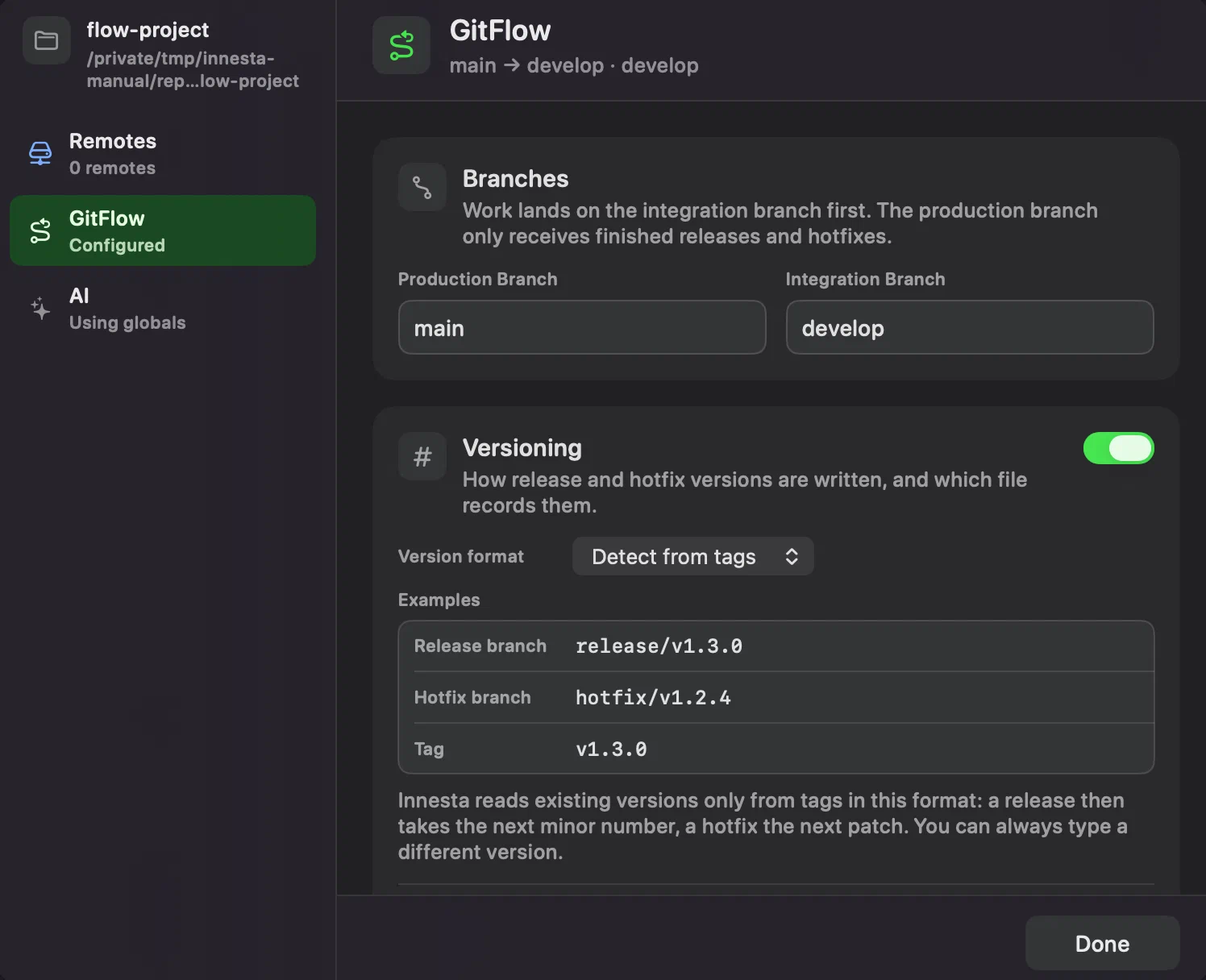
- Stores the production and integration branches. The defaults are
mainanddevelop. - Creates the integration branch if the repository does not have one.
- Writes the standard prefixes:
feature/,release/,hotfix/,support/.
Where the settings live
In the repository’s Git config: the branch names and prefixes under
gitflow.branch.* and gitflow.prefix.*, which are the keys every GitFlow tool
uses, and Innesta’s own settings under innesta.*.
The innesta.* keys are read, written and cleared in Git’s --local scope and
nowhere else. That is deliberate. A global or worktree value for the same key
would override the repository’s, so a setting you cleared would appear to come
back, and a repository would behave differently on two machines for reasons
nothing on screen explained.
A repository configured by another GitFlow tool is detected, not reconfigured: either branch key being present is enough to mark it as set up.
While you edit
Settings apply as you type them, once typing settles or when you press Return. An invalid branch name is ignored by the autosave rather than written; pressing Return on one gives you the validation error, so you find out either way but are not interrupted mid-word.
Each control writes only its own key, and the writes are ordered, so editing several things quickly cannot land them out of sequence.
Where the status is
Not in the settings panel itself. Inside Repository ▸ Repository Settings… it is the sheet’s own list of sections and the bar above it that carry the glyph, whether GitFlow is configured, the branch pair, and a badge for what kind of flow branch you are on. The GitFlow popover in the toolbar repeats it, which is where you will usually read it.
The panel does warn about one thing: a stored branch name that matches no branch in the repository. Without that warning, GitFlow actions would fail with nothing on screen explaining why.
Turning Versioning off
Disabling Versioning keeps your saved settings and any manual names. Tags are still created and collisions are still checked; the suggestions, the prefix-aware behaviour and the manifest integration stop. Turning it back on finds everything as you left it.