The Innesta window
One window, three columns, a toolbar and a status bar — and what each of them is for.
Innesta shows one repository per window, and the window has the same shape
whatever you are doing in it. Learning where the four regions are is most of
learning the app.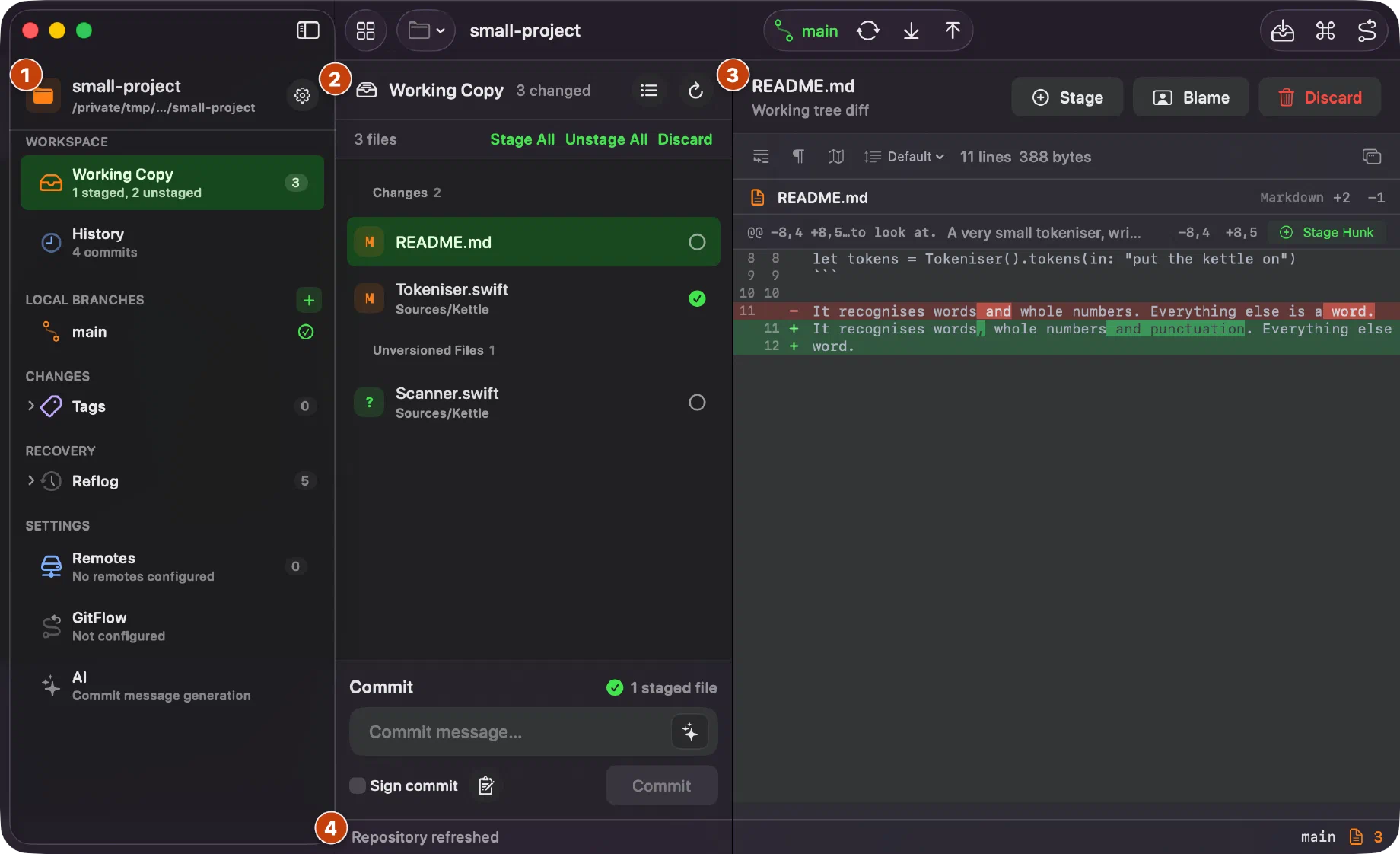
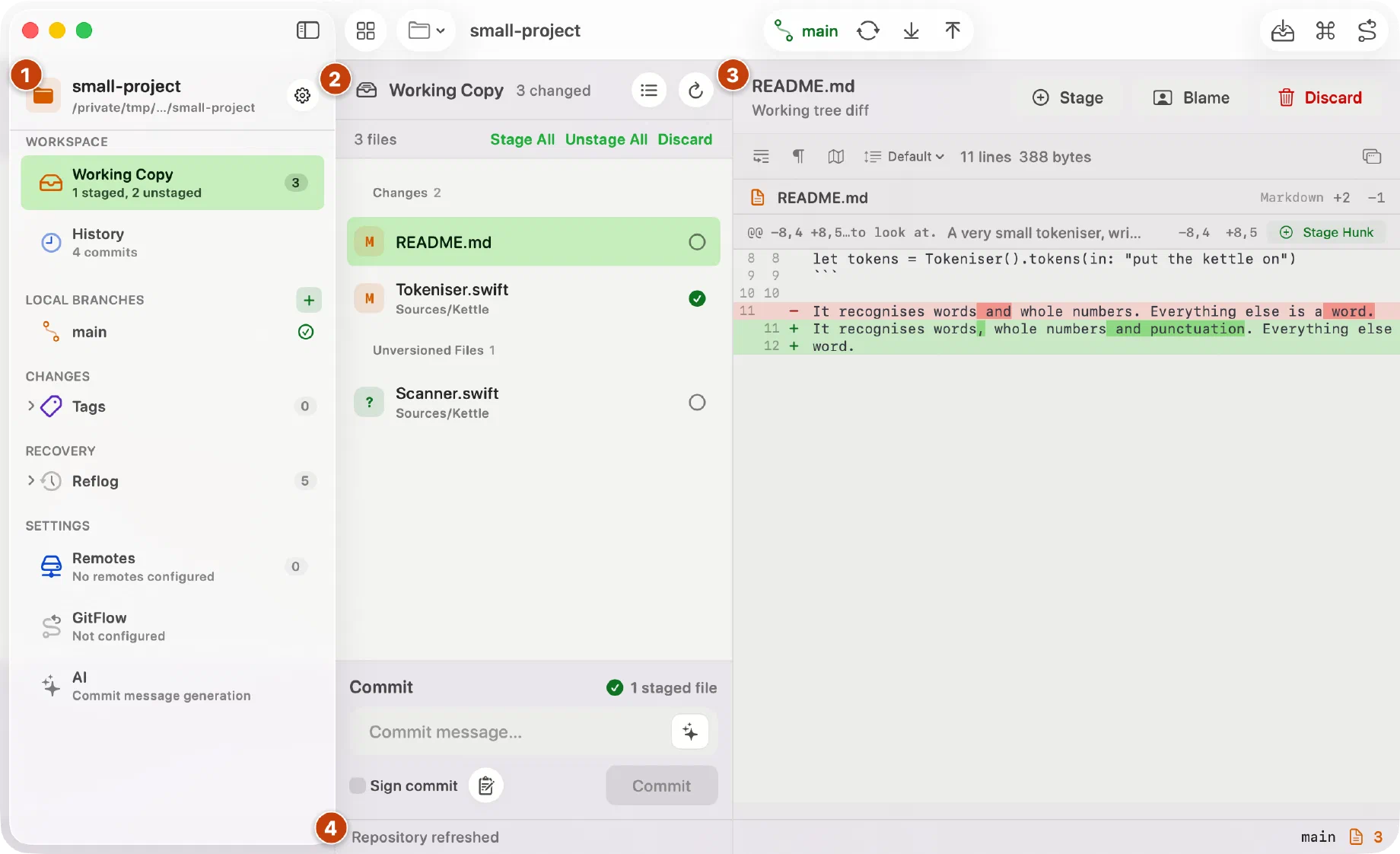
1 — The sidebar is the repository itself: the working copy, the history, your branches and tags, the remotes, and the Recovery section that holds the backups Innesta takes before anything destructive. Selecting an item here changes what the other two columns show.
2 — The middle column is whatever the sidebar selected. On the working copy it is the list of files that have changed, with the commit panel underneath it. On the history it is the list of commits. On a stash it is the files that stash holds, and nothing underneath, because there is nothing there to commit.
3 — The right-hand column is the detail of whatever is selected in the middle: the diff of a file, or the contents of a commit.
4 — The status bar runs along the bottom. At the left it shows the last thing Innesta did; at the right, the branch you are on and how many files have changed. The branch is a label. The file count is a button, and pressing it selects the working copy. Beside it, when there is something to pull or push, a pull and a push control appear, and they do what they say.
The toolbar
The toolbar carries the operations that act on the repository as a whole rather than on one file. Reading across: the sidebar toggle, the Projects list and the repository actions menu; in the middle, the branch switcher and three sync buttons; and at the right, Stash, the Command Palette and GitFlow.
The three in the middle are Sync with Remote, which fetches, and Pull and Push, which carry a badge with the number of commits waiting in each direction. The one that decides between them for you is a command rather than a button: see sync.
Getting anywhere quickly
Repository ▸ Command Palette (⌘K) opens a searchable list of the most-used actions, each showing its key equivalent where it has one. It is the fastest way to reach something you know the name of, and the fastest way to learn the shortcut for something you keep reaching for with the mouse.